
Here's a number that should bother you: contractors who implement Performance Pay see a 12–15% lift in production within 90 days. Their workers earn 10% more per week. Turnover drops. Callbacks drop. Margin goes up.
And yet most companies who try it abandon the program by month three.
It's not that performance pay doesn't work. It's that the rollout was broken from the start — wrong people included, goals no one believed in, communication that happened once and never repeated. The math wasn't the problem. The execution was.
If you're building a pay-for-performance program — or trying to rescue one that stalled — here's what the successful ones actually look like.
Performance pay creates a genuine win-win: workers earn more when they produce more, and the company captures the upside of that extra production. But the win-win only materializes if three things are done correctly: who's included, what the goals are, and how the program is communicated. Get one of those wrong and the program quietly dies.
Decide who's in — and actually decide it.
The default move is to throw every field worker into the program at once. That's almost always a mistake. Not because performance pay shouldn't eventually reach everyone, but because rolling it out to a 40-person crew on day one creates more confusion than momentum.
Start with your A-listers — the workers who already show up early, push the pace, and take callbacks personally. These are the people who will thrive under performance pay from the first week. Their results become your proof of concept and your sales pitch to the rest of the crew.
Who belongs in the program
- Field workers with hourly-based pay — not salaried supervisors or office staff
- Workers who have enough autonomy to influence job speed and quality
- Crew leads who make real decisions about how jobs are approached
- Anyone who's consistently complained that the flat wage "isn't fair" — because they're right
"The workers who push back hardest on performance pay are usually the ones who've been coasting. Your best people are almost always quietly in favor of it — because they've been subsidizing the slow ones for years."
Once the initial group is identified, resist the temptation to assume they already understand the model. Even workers who nod enthusiastically in the meeting may not fully grasp how their bonus is calculated or what specific behaviors move the number. Take the time to walk through the mechanics, in plain language, before a single job starts.
Set goals workers can actually believe in.
This is where most programs break. Owners set production targets based on what the business needs — not what's realistically achievable for a crew doing actual work in real conditions. Crews take one look at the numbers, decide they're out of reach, and mentally check out within the first week.
Performance pay only creates motivation when workers believe — genuinely believe — that the goal is within reach if they push. The moment a target feels rigged or arbitrary, the program is done. You've just added paperwork.
The four questions to ask before setting any goal
- Are my job budgets realistic? If you're losing money bidding jobs, a performance program won't fix it — it'll just add a bonus problem on top of a margin problem.
- Do workers have a realistic chance of hitting the target on a normal day? If only your top 5% can ever earn a bonus, you don't have a performance program. You have a lottery.
- Am I setting them up to succeed? Correct materials on site, accurate drawings, job-appropriate equipment — if those aren't in place, crews are fighting the company, not racing the clock.
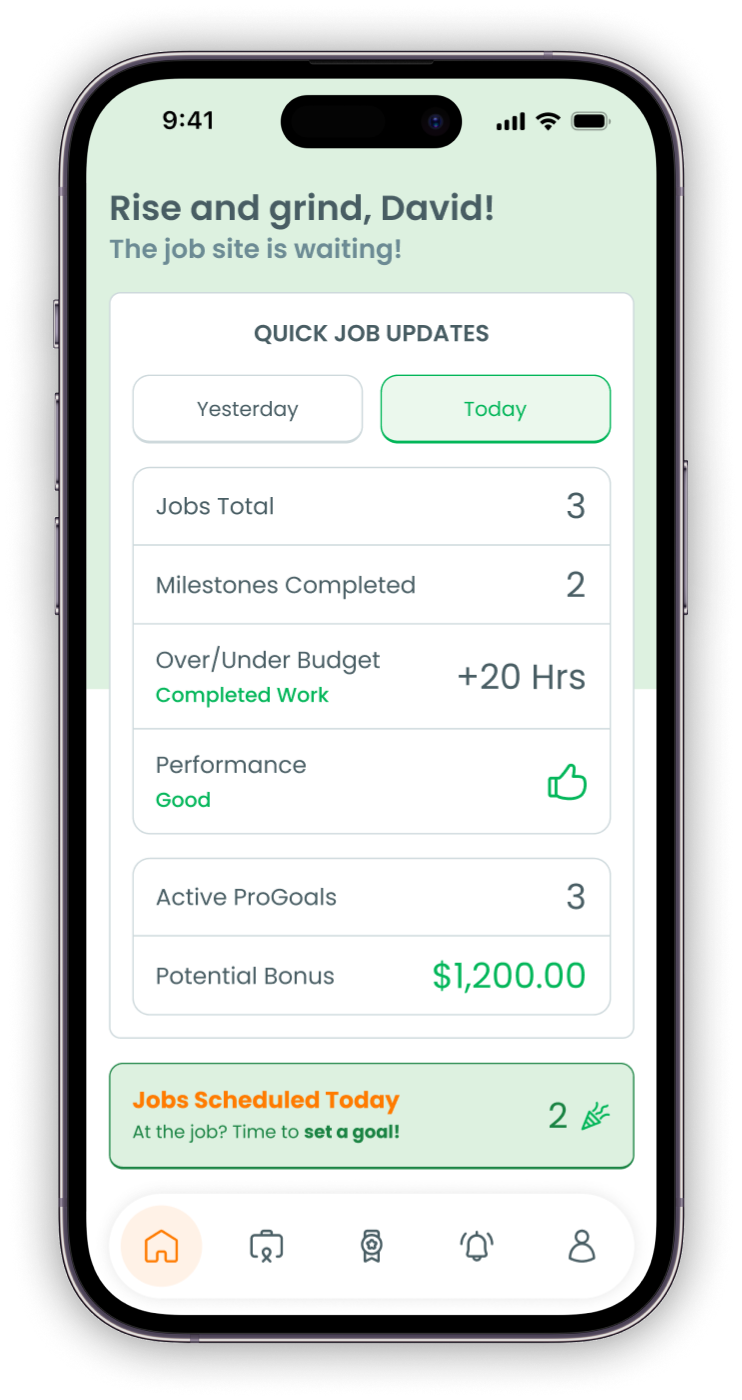
- Is the goal visible in real time? Workers who can't see their progress mid-job have no way to adjust their behavior. Visibility is the mechanism. Without it, the goal is just a number on a printout no one reads.
A foreman tells the crew at the start of a job: "The budget is 20 hours. If we finish in 16, there's a $150 bonus to split." That's it. Specific, time-bound, in plain language, with a dollar amount everyone can calculate their share of. Proti's worker app shows this live so they can see exactly where they stand throughout the day.
One more thing on goals: collaborate with your workers to set them, at least the first time. You don't need consensus on every budget line. But if crew leads feel like the targets were handed down from someone who's never run a job, they'll treat them accordingly. Ask what a "good day" looks like on that job type. Let their answer inform the standard.
Communicate like it's your job. Because right now, it is.
The single most common thing we hear from contractors whose programs stalled: "We launched it, and then we just kind of moved on."
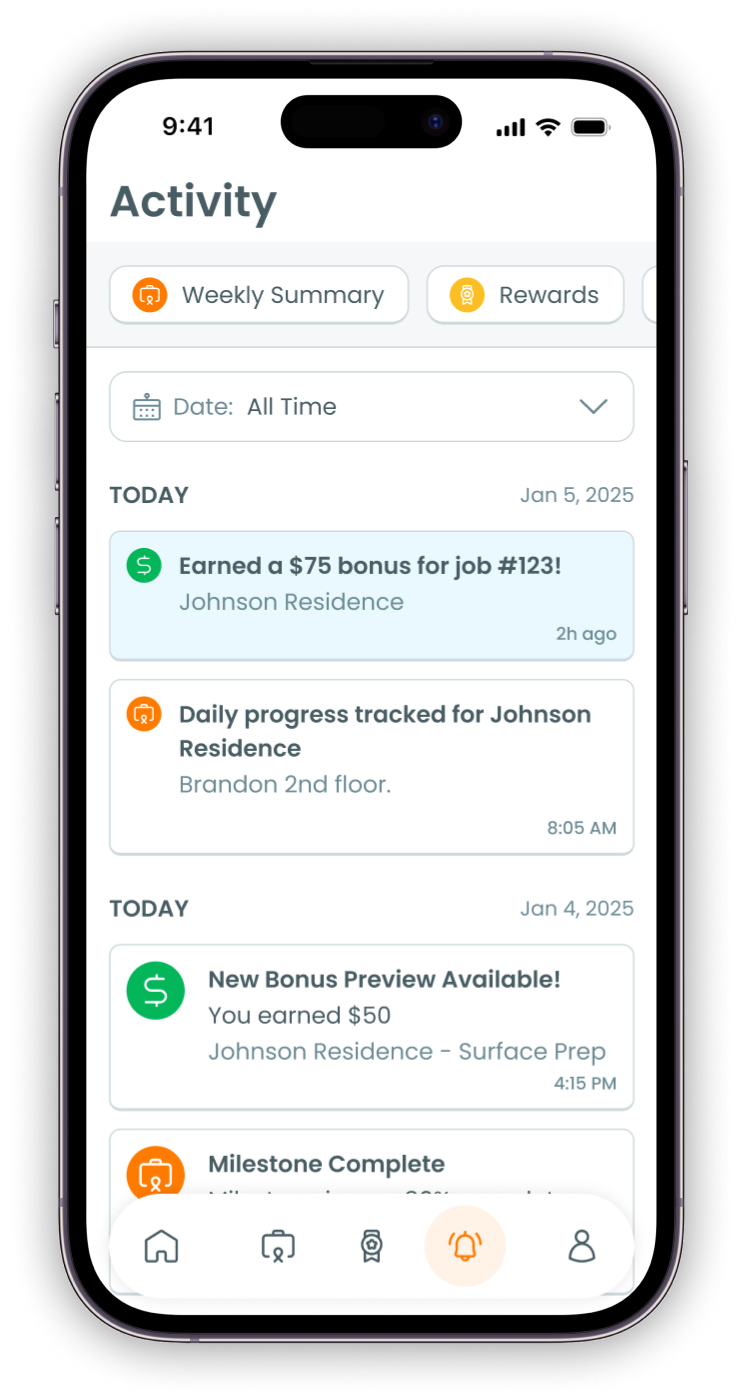
Performance pay is not a policy you set and forget. It's a behavioral system — and behavioral systems require consistent reinforcement to work. One announcement, no matter how clearly worded, does not change how crews think about production. Repetition does.
What high-performing operators actually do
"The companies that get lasting results from performance pay aren't necessarily the ones with the best-designed programs. They're the ones where the foreman mentions the goal every single morning without exception."
Communication also has to cover the hard stuff. What happens when a job goes over budget? What if a worker thinks the goal was unfair? What if someone's bonus is cut because of a quality issue? These conversations are uncomfortable, but they're far less uncomfortable when workers already understood the policy before it applied to them.
Write it down, share it before the first job under the new system, and make sure every worker on the program has read it. Not because you'll need it as evidence in a dispute — but because clear rules make disputes much less likely.
What happens after the first 90 days
If you've done these three things correctly, something will have changed by the end of the first quarter. Not just the production numbers — the culture.
Workers start talking about jobs differently. Not "how long do I have to be here today," but "how close are we to the number." Crew leads start managing differently. The foreman who used to shrug at a crew running slow now has a concrete reason to address it — because a slow crew is a smaller bonus for everyone, including him.
This is the compounding effect that makes performance pay worth the investment in setup. The first month, you're tracking numbers. By month three, your crew is tracking numbers for you.
Ready to run your own program?
A 30-minute Protiv demo walks through exactly how to structure goals, set rates, and roll out the program for your specific job types.