
That is the short answer. Below: why hourly alone stalls, when “by the job” goes wrong, how a budget-beating bonus works with numbers, the failure modes that kill most programs, and how to run it week to week without an admin babysitting spreadsheets.
Why hourly pay alone works against you
Hourly pay is simple, compliant, and familiar. It is also a structural mismatch with how you get judged as an owner.
You are measured on margin and labor as a share of revenue. Your crews are measured on hours worked. Those are two different scoreboards. Under a flat hourly wage, finishing early does not put an extra dollar in anyone’s pocket. Stretching a job does. A slow day pays the same as a great day — often more, because more hours hit the clock.
That is a pay-design problem before it is a culture problem. Construction labor productivity barely moved for two decades while the rest of the economy pulled ahead (McKinsey Global Institute, Reinventing Construction, 2017). When one national trade company switched from paying for time to paying for output, output rose 44% (Lazear, “Performance Pay and Productivity,” American Economic Review, 2000). The crews already knew how to move faster. The paycheck did not ask them to.
Owners feel it as death by a thousand cuts: the truck leaves at 7:20 instead of 7, an extra supply run, waiting on materials, the wrong crew size, rework, overtime creep. None look dramatic on one job. Across a season, they are your labor %.
What “pay by the job” usually means — and why owners flinch
When an owner says “pay by the job,” they often mean one of three different things. Mixing them up is where rollouts go sideways.
1. True piece-rate. The hourly wage is replaced (or largely replaced) by a price per unit, stop, or completed job. Speed is rewarded. Base pay for clocked hours is no longer the floor. That can work in narrow settings, but it brings wage-and-hour complexity and crew pushback — especially when a job runs long for reasons outside the crew’s control.
2. A flat job bonus on top of hourly. “Finish the patio, get $200.” Simple to explain. Hard to keep fair. Flat bonuses ignore budget size, crew size, and whether quality held. They also tend to become an expected raise instead of an earned share of savings.
3. A share of labor savings against a real budget. The crew keeps the full hourly wage for every hour worked. If they beat the labor budget, the dollars they did not spend are split between the company and the people who did the work. Over budget, the bonus is zero — base pay does not change. This is performance pay sitting on top of hourly, not instead of it.
For most trade contractors, option 3 is the one that survives payroll, finance, and the field. It is not piece-rate. Base pay stays intact. The bonus cannot exceed the savings, so payroll does not go up to fund the program.
A worked example: same patio, two pay designs
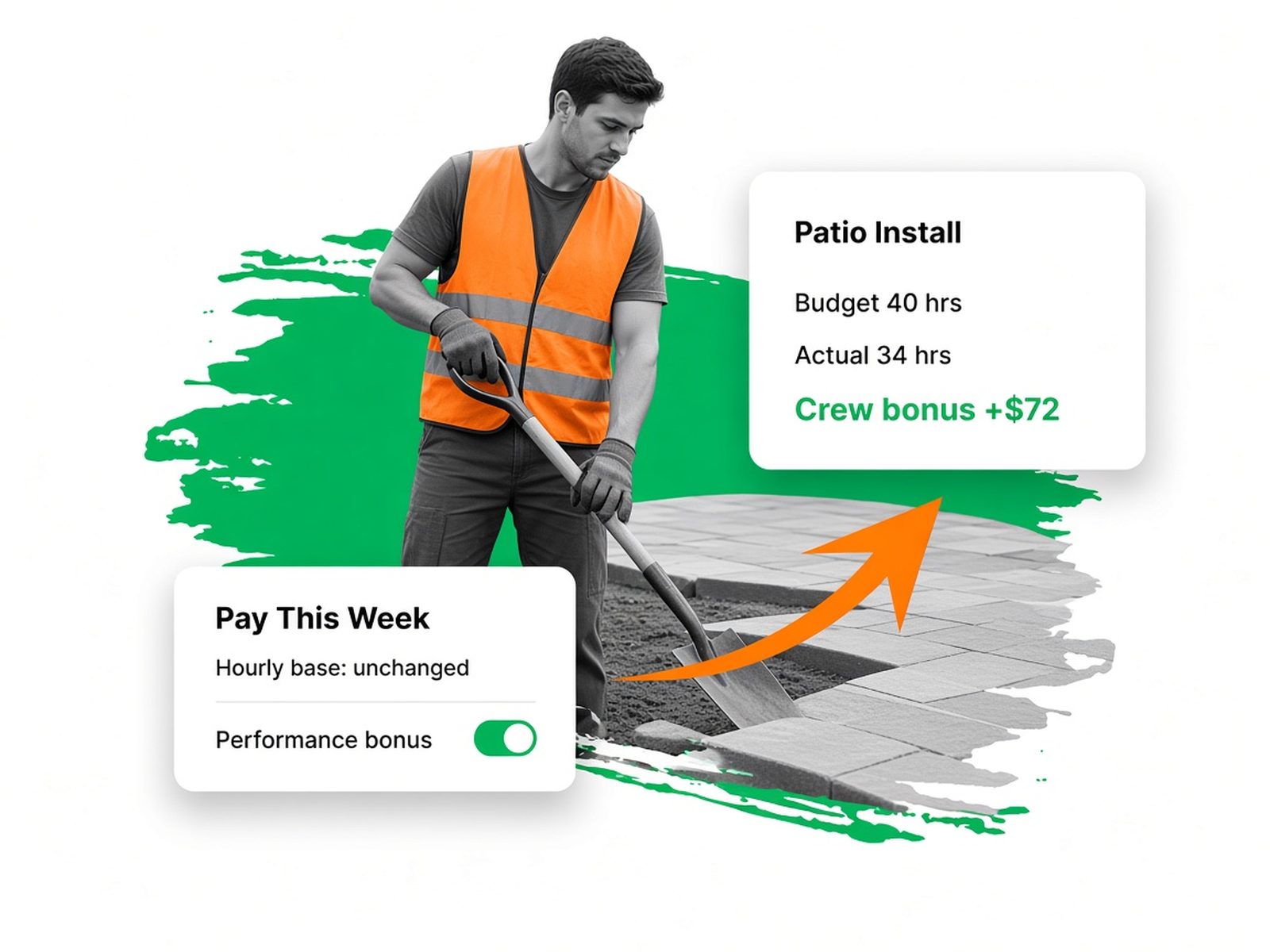
Labor budget: 40 hours.
Actual: 34 hours.
Loaded labor rate for the example: $24/hour.
Hours saved: 6
Savings: 6 × $24 = $144
Under a common 50/50 split:
- Company keeps $72 (lower labor cost on that job, or capacity for the next one)
- Crew pool earns $72 (on top of the wages already paid for the 34 hours)
Under pure hourly, that crew just lost six hours of wages by finishing early. The owner got the efficiency; the people who created it got nothing extra. Next time, the incentive is to let the day fill the clock.
Under a savings-share bonus, the same early finish puts money in both pockets. Over budget? Bonus is $0. Nobody’s base rate drops. That rule is what separates this from piece-rate in the eyes of the crew — and the first sentence you should say in the kickoff meeting.
Match the incentive to the work — “by the job” is not one size
Most companies do more than one kind of work. Using one bonus shape for everything is how programs feel unfair by week three.
| Type of work | Better fit | Why |
|---|---|---|
| One-off installs, enhancements | Job labor budget | Beat the hours on that job; share the savings |
| Recurring maintenance routes | Weekly (or bi-weekly) route / group budget | One slow stop should not wipe out the week |
| Large multi-week commercial jobs | Phased budgets | Pay by phase; hold part until the job closes so margin lasts |
| Techs, specialists, some sales roles | Production / revenue tiers | Output ladders when a job budget is the wrong unit |
| Every crew, every payout | Quality and safety gates | Fast never beats safe or right |
Incentives can stack: a crew can earn on the jobs they finish and share in a branch goal. The mistake is forcing a maintenance route through a per-stop piece bonus, or paying a six-week install as one lump at the end with no holdback.
Failure modes: why “we tried bonuses” usually ends
Roughly four out of five owners who try a bonus program in spreadsheets eventually quit — not because the idea was wrong, but because running it every week is hard. Common failure modes:
Nobody can see the score mid-week. If crews only learn what they earned on payday, the bonus is a surprise, not a motivator. Surprises get argued; arguments kill trust.
The first payout is late, short, or unexplained. Crews do not decide if a program is real at the kickoff meeting. They decide on the first check. A clear $100 beats a vague $200.
Budgets were never honest. If half the crews could never have earned under last year’s numbers, you launched a morale problem. Model the last twelve months before anyone sees a target.
Deductions feel random. Callbacks and quality holds have to be written rules, visible the day they happen — not a surprise on the statement.
Admin collapses the program. Hours span hundreds of jobs; crews change every week. A manager with seven crews can face 140+ manual approvals. When approvals slip, belief slips.
The bonus turns into an expected raise. If people get paid whether or not they beat the budget, you raised wages. You did not buy performance.
How to run it without drowning in spreadsheets
You do not need a new religion. You need a weekly loop that survives a busy season.
- Start from your own history. Before go-live, review twelve months: labor as a share of revenue, budget vs actual, who would have earned under the split you are considering.
- Write the rules once. Target, formula, eligibility, what a callback does, which paycheck it lands on. Apply it the same way for the senior foreman and the new hire.
- Say the base-pay line first. Base wage is not changing. This sits on top. Repeat it until you are tired of hearing yourself.
- Make the score visible every day. Hours left, pace, potential share — in the language your crews actually use.
- Approve on a cadence. Flag exceptions, approve what is clean, pay what was earned. If it takes more than about twenty minutes a week once data is flowing, the process is still too manual.
- Pilot small. One branch, a few crews, ninety days. Expand only after the first payouts were on time and explainable.
What “good” looks like when pay follows results
You are not looking for a hero week. You are looking for labor’s share of revenue to move while crews take home more — funded by production, not by a bigger payroll line.
Promier Landscapes (Kingsport, TN; 35 field staff; verified by an outside landscaping CFO at B Advisory) ran a year on this model with headcount flat: revenue +17.5% ($7.5M → $8.8M), labor cost as a share of revenue 21.8% → 19.9% (−1.9 points), about $165,000 in field labor savings, and 4,877 hours moved back toward billable work. Same crew. More output. Bonuses paid from the savings.
Mulhall’s Landscaping (Omaha; 30+ years): Mick Mulhall — “Protiv has been the most impactful thing we've ever done to drive operational performance. We saw the impact in one month.”
Those are landscaping case studies, not a promise every trade will move the same points. They show hourly base plus earned share of savings can move both scoreboards when the middle of the program actually runs.
Where Protiv fits (after the decision, not instead of it)
If pure hourly is leaving margin on the table and pure piece-rate is the wrong risk, what remains is operations: budgets, hours, approvals, statements, and a live crew-facing score.
That is the lane Protiv is built for — turning job budgets and actual labor into transparent performance pay so crews work like owners, with quality and safety gates on every bonus. The product is not the answer to “hourly or by the job?” The answer is the framework above. The product is how you run it every week without a second job in Excel.
FAQ
Is performance pay the same as piece-rate?
No. Piece-rate replaces (or largely replaces) the hourly wage with a price per unit or job. Performance pay of the kind described here keeps the full hourly wage for every hour worked and adds a bonus funded by labor savings when the crew beats a budget. Over budget, the bonus is zero; base pay does not drop. That distinction matters for crew trust and for how you talk about the program with finance.
Will my best people earn less if we stop paying only by the hour?
Usually the opposite, if the budgets are honest. Top crews who already finish clean and early are the ones hourly pay under-rewards today. A savings share pays them for output they were already creating. The people who lose relative ground are the ones who only looked productive because the clock was running. Still: model your last twelve months before launch so you can see who would have earned under the rules you are about to announce.
What if a job runs long because of weather, materials, or a bad estimate?
That is a budget and eligibility problem, not a reason to abandon performance pay. Separate “crew behind on a fair budget” from “budget was wrong from the start.” Hold or adjust when the cause was outside the crew’s control. Blame every overage on the crew and trust dies; excuse every overage and you are back to an expected raise.
How do I keep quality from slipping when speed pays?
Do not pay for speed alone. Every bonus should clear safety and quality gates first: an incident can stop the bonus; work has to pass the walkthrough; callbacks come off the next check. Example pattern: crew earns $400, quality and safety pass, one callback deducts $50, a portion is held for the callback window, and the remainder pays now. Crew leaders should see the flag the day it happens — not as a surprise on payday. Fast never beats safe or right.
Should maintenance crews and install crews use the same bonus rules?
Rarely. Installs and enhancements fit job-by-job labor budgets. Recurring routes usually need a weekly or bi-weekly group budget so one tough stop does not erase the week. Long commercial jobs need phases with part of the bonus held to close. Specialists often need production or revenue tiers. Same philosophy — share real savings or hit a real target — different unit of work.
How big should we start?
Small enough that you can explain every first payout in person. One branch or a handful of crews for about ninety days is enough to test budgets, visibility, and approvals. Expanding a broken process multiplies distrust; expanding a clean first payout is how the rest of the company asks to be next.
Soft next step
If you want to see what a savings-share model would have paid on your last twelve months — who would have earned, which budgets were too tight, where the hours went — walk those numbers before you announce anything to the field. That pre-launch look is the difference between a program crews believe and one they write off after the first confusing paycheck.
Talk to the Protiv team when you are ready to model it on your data.
See what this looks like for your crews
A free 30-minute Performance Forecast models the incentive against your actual job data — no commitment.