
Below: why the fear is reasonable, a gated bonus with real numbers, the mistakes that make gates feel unfair, and how to run it without a weekly argument.
Why owners are right to worry
The fear is not paranoia. Anyone who has run crews has seen a flat "finish by Friday and get $200" deal turn into ragged edging, half-done cleanup, and a skipped tailgate safety talk. The crew did exactly what the deal asked. It asked for speed and nothing else. Whatever you leave out of a pay plan, people learn to trade away.
But the alternative is not quality. Under pure hourly pay, the incentive is "let the day fill the clock." Hourly does not buy quality; it buys time. You still inspect, still chase callbacks, and still eat the rework, and nobody on the crew has a financial reason to care. (For why hourly alone stalls, see Should I pay my crew hourly or by the job?)
So the real question is whether you can write a performance pay plan where quality and safety are part of the score. You can. It just has to be designed in on day one, not bolted on after the first bad job.
What a gated bonus looks like
Start with the base model. The crew keeps its full hourly wage for every hour worked. Each job has a realistic labor budget. If the crew beats the budget, the labor dollars it did not spend are split between the company and the crew. Over budget, the bonus is zero and base pay does not change.
Now add the gates. Before any bonus pays, it has to pass a set of written checks:
- Safety. An incident or violation on the job stops the bonus. Not reduces it; stops it.
- Quality. The work has to pass the walkthrough, whether that is a crew lead sign-off, a manager inspection, or a customer punch list.
- Callbacks. If rework shows up later, the cost comes back off the next check. The crew does not get to keep a bonus on work that had to be done twice.
- Holdback. Part of the bonus is held for a set window, often 30 days, so there is money left to true up against callbacks that surface after payday.
Every one of those is a reason not to rush. A crew that skips steps to save an hour is putting the whole bonus at risk for a small gain.
The worked numbers: a $400 bonus that pays $280
Here is how a gated payout plays out on a single crew bonus. These are example numbers, but the mechanics are the ones a real program uses.
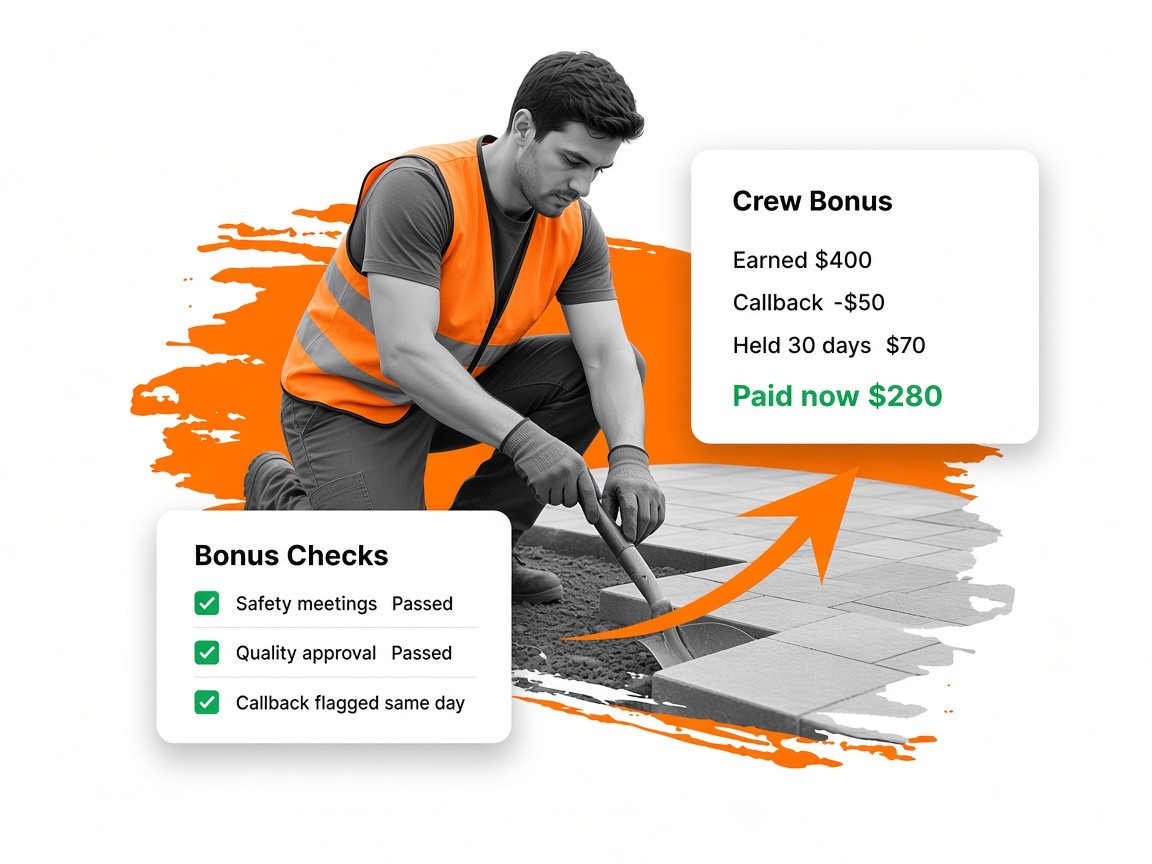
- Crew bonus earned on budget savings: $400
- Quality approval: Passed
- Safety meetings: Passed
- Callback on one stop: −$50
- Held for 30 days: $70
- Paid now: $280
Walk through it. The crew beat the budget and earned $400. It cleared quality and safety, so the bonus is alive. One stop had a callback, so $50 comes off, leaving $350. Twenty percent of that, $70, is held for 30 days in case anything else surfaces. The crew gets $280 on this check and the $70 later if the window closes clean.
The crew still got paid well; gates are not a trick to avoid paying bonuses. But the callback cost real money the crew could see. Hourly pay never gives you that feedback loop.
Run the math on a rushed job
Now look at it from the crew's side, where the decision to rush gets made. Take a 40-hour patio with a $24 loaded labor rate and a 50/50 split. Done right, the crew finishes in 34 hours. That is 6 hours saved, $144 in savings, and $72 to the crew pool.
Say they rush instead and finish in 31 hours. That is 9 hours saved, $216 in savings, and $108 to the crew pool, a $36 gain on paper. But rushing is how you skip the final compaction pass or leave the joints half-swept. Now imagine the walkthrough catches it, or the homeowner calls three weeks later. Under the rules above, one of two things happens:
- The walkthrough fails. The bonus is held until the work is fixed. The crew spends extra hours making it right, the job is no longer under budget by much, and the $108 shrinks or disappears.
- A callback shows up later. The cost comes back off the next check, and there is a holdback sitting there to cover it.
The crew that rushed traded a likely $72 for a possible $108 that will probably turn into much less. Once crews see that on their own statements, rushing stops looking like a good bet. You are not asking crews to resist an incentive; you are building one that already points at doing it right.
How to write the gates
Gates only work if the crew believes they are fair, so write them before launch and apply them the same way to everyone.
Safety: list what counts (a recordable injury, a vehicle incident, a missed required safety meeting, a PPE violation) and keep it binary. Quality: say who signs off, what they check, and how fast; a gate that takes two weeks to clear is a payroll problem. Callbacks: define a callback as rework the crew caused, not a customer changing their mind, and say how long the window runs. Holdback: roughly 20% for 30 days is a reasonable starting point on install work; on long multi-week jobs, pay by phase and hold part until the job closes.
Failure modes: when gates backfire
Gates can kill a program as fast as a lack of gates.
Deductions feel random. A callback deduction discovered on payday reads as the company clawing back money. Crew leaders should see a flag the day it happens, so payday holds no surprises.
Gates are vague. "Quality has to be good" is an argument waiting to happen. If crews cannot predict a pass, they assume the owner decides after the fact.
Charging callbacks the crew did not cause. Customer changes, bad materials, and estimating misses are not crew callbacks. Charge them to the crew and everyone learns the rules are rigged.
Holds that never release. Set a date, show it, and pay on that date if nothing came up.
Budgets that force rushing. If a budget cannot be hit without cutting corners, the crew either rushes and fails the gate or works properly and earns nothing. Check budgets against the last twelve months before launch; if a job type has never come in under budget, the budget is the problem.
Speed is all anyone talks about. Celebrate the clean walkthroughs and zero-callback months, not just the fast jobs.
How to run it week to week
- Write the rules once, in plain language. One page, translated if your crews work in Spanish or Portuguese.
- Say the order at kickoff. Safety first, then quality, then the bonus. Base pay never changes.
- Show the score and the flags together. Hours left, what the crew is on pace to earn, and any flags, every day.
- Flag the day it happens, with a reason.
- Approve weekly. Review flags, approve clean jobs, release cleared holds. If it takes more than about twenty minutes a week once data flows, it is still too manual.
- Review quarterly. Callback rates, which gates fired, which budgets were too tight. Adjust openly.
Match the incentive to the work, too. Maintenance routes usually fit a weekly route budget, so one slow stop does not tempt anyone to rush the next five.
What it looks like when it works
You are looking for two scoreboards moving together: labor's share of revenue down, crew pay up, with callbacks flat or falling.
Promier Landscapes (Kingsport, TN; 35 field staff; numbers verified by an outside landscaping CFO at B Advisory) ran a year on this model with the same crew: revenue +17.5% ($7.5M to $8.8M), labor cost as a share of revenue 21.8% to 19.9% while wages went up, about $165,000 in field labor savings, and 4,877 hours moved back to billable work. Their operations manager, Chris Kelso: "It's reducing man hours. For folks that are bonus driven, it's working."
Mulhall's Landscaping (Omaha; 30+ years in business): Mick Mulhall said, "Protiv has been the most impactful thing we've ever done to drive operational performance. We saw the impact in one month."
Those are landscaping results. HVAC, plumbing, electrical, and other trades can set up the same gates (service calls and installs each get their own budget shape), but those two case studies are the proof points, not a promise for every trade.
Where Protiv fits
Running this is the hard part: tracking which jobs passed the walkthrough, which had callbacks, what is held and when it releases, and making all of that visible to crews before payday instead of after.
That is what Protiv is built for. Safety and quality rules sit on every bonus. Disqualifiers and penalties can be applied to a payout, held amounts are tracked in a held bonus ledger with a release date the crew can see in the app, and crew leads see flags the day they happen. Managers approve from one screen. The rules are yours; the software keeps them consistent.
FAQ
Should a safety incident wipe out the whole bonus?
For most companies, yes, at least the bonus tied to that job or period. The point of a safety gate is that it is not a trade-off. If a crew can do the math on "an incident costs us $40, but rushing earns us $100," you have made safety negotiable. A clear stop removes that math. What you can decide is the scope: one job, one pay period, or the whole crew versus the person involved. Write that down before launch so nobody is negotiating it the day after an incident.
Who should decide whether a job passes quality?
Someone who is not on the crew and who can get to it quickly. In smaller companies that is often the owner or an operations manager; in larger ones it is an account manager, a superintendent, or a quality lead. Speed and consistency matter more than who: a same-week walkthrough against a known checklist builds trust, while one that happens whenever someone gets around to it makes crews suspect a stalling tactic.
What counts as a callback the crew should pay for?
Rework caused by how the crew did the job: missed steps, poor workmanship, damage they caused. Not customer change orders, design or estimating mistakes, material defects, or weather damage. If crews get charged for callbacks they did not cause, the callback rule stops working as quality feedback and starts looking like a way to claw back pay. When in doubt, investigate before deducting and tell the crew lead what you found.
How much of a bonus should we hold back, and for how long?
Match it to your callback risk. A common starting point on install work is holding around 20% for 30 days, which in the example above meant $70 of a $350 bonus. Maintenance work with low rework risk may need a shorter window or a smaller hold. Long multi-week jobs often work better with phases, where each phase pays and a portion is held until the job closes. Whatever you choose, show the held amount and its release date to the crew, and release it on time when nothing comes up.
Won't crews just argue every deduction?
Some will at first. Arguments get worse when deductions are surprises, when the rules are vague, or when the crew finds out on payday. They get much quieter when the flag shows up the same day with a reason, the rule was explained at kickoff, and the crew lead can see the same numbers the manager sees. Give crews one clear way to dispute a flag, review it quickly, and reverse it openly when they are right.
Soft next step
If rushing is the thing keeping you from trying performance pay, start by writing your gates: what stops a bonus, who signs off on quality, what a callback costs, and how much you hold back. Then look at your last twelve months and ask how many jobs would have cleared those gates under budgets your crews could actually hit.
When you want to model it on your own data, talk to the Protiv team.
See what this looks like for your crews
A free 30-minute Performance Forecast models the incentive against your actual job data — no commitment.