
Below: what the 90-day curve looks like, three sets of worked numbers that show where programs actually break, the failure modes to watch for, and a week-by-week plan for getting past day 90.
It is not the goal. It is the middle.
When owners tell me "we tried bonuses and it didn't work," I ask what happened in month two. The answer is rarely "the crews didn't want more money." It is usually "we got busy." Here is the curve most programs follow:
- Weeks 1 to 2: launch energy. Crew leads ask about targets. The first jobs come in under budget because everyone is paying attention, including the owner.
- Weeks 3 to 8: the middle. Peak season hits. The person running the spreadsheet is also running dispatch. Approvals slide from weekly to "when I get to it." A crew lead asks about a missing bonus and hears "I'll look into it."
- Weeks 9 to 12: the verdict. Crews have stopped checking. The bonus became either a random surprise or an expected raise. Either way it no longer changes how anyone works. The owner sees no movement in labor cost and pulls the plug.
The goal was fine. Nobody kept the middle running.
Worked numbers #1: the budget no crew could beat
The fastest way to kill a program is a budget the crew cannot win. These numbers are illustrative, but the pattern is common.
Say a weekly maintenance route has historically taken about 45 crew hours when it is run well. Someone sets the bonus budget from the bid instead of from history, and it comes out at 37 hours, roughly 18% too tight.
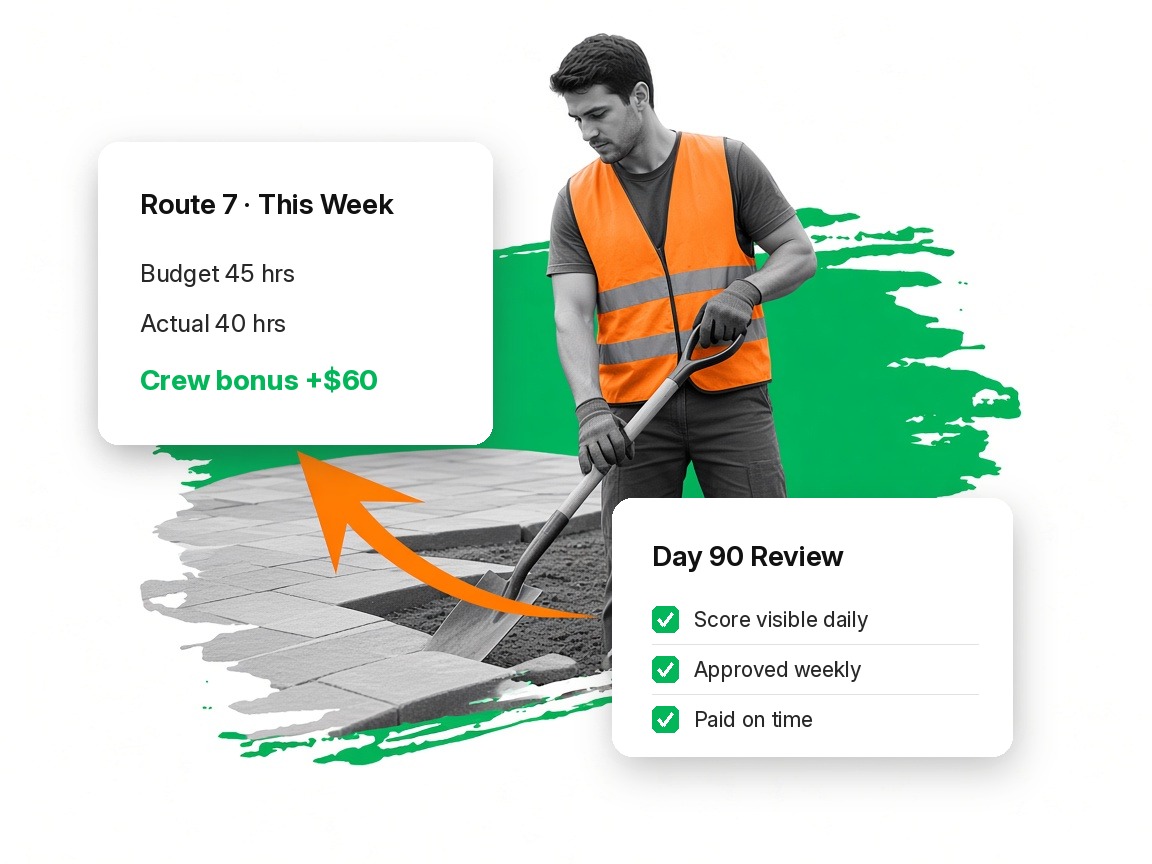
Now the crew has a genuinely good week: on time every morning, no extra supply runs, done in 40 hours, five better than normal.
- Against the too-tight 37-hour budget: 40 hours is over budget. Bonus: $0.
- Against an honest 45-hour budget: 5 hours saved × $24 loaded rate = $120 in savings. Under a 50/50 split, the company keeps $60 and the crew earns $60.
Same crew, same great week. One version teaches them effort pays; the other teaches them the program is rigged. Repeat that for a month and nobody cares by day 90.
The fix happens before launch: check every budget against the last twelve months of actual hours. If a route has never come in under budget, the budget is the problem, not the crew. (For how the savings split itself works, see Should I pay my crew hourly or by the job?)
Worked numbers #2: what the middle costs a manager
The second killer is admin. Here is an illustrative week for a manager with seven crews, each finishing about five jobs:
- 35 jobs to close out
- For each one: confirm the hours landed on the right job, check the budget, check for a callback or a quality flag, approve, and record the payout
- At about 4 minutes per job, that is 140 minutes, well over two hours, before a single crew question or dispute
Four checks on each of 35 jobs is how a manager with seven crews ends up facing 140 or more approvals in a spreadsheet program. Two hours sounds fine in February. In May it is the first thing skipped, and when approvals skip a week, payouts skip a week, and crews notice.
The benchmark: once data is flowing, the weekly approve-and-pay routine should take about 20 minutes. If your process cannot get close, it will not survive busy season.
Worked numbers #3: the expected-raise trap
The third failure looks like generosity. A crew misses budget on a tough week, and the owner pays the usual bonus anyway "to keep morale up."
Illustrative math for one branch with five crews over a 12-week pilot:
- Each crew misses budget on 4 of its 12 weeks
- The owner pays an average $60 goodwill bonus on each of those missed weeks anyway
- 5 crews × 4 weeks × $60 = $1,200 paid out with zero savings behind it
The money is not the real cost: you told every crew the bonus arrives whether or not they beat the budget. That is a raise with extra steps, and the first time you enforce the rule it feels like a pay cut.
The rule has to hold from week one: over budget, the bonus is zero and base pay does not change. If a job ran long for reasons outside the crew's control, adjust the budget openly with a written reason. That is a correction, not a gift, and crews can tell the difference.
Failure modes: what to watch between week 4 and week 12
Catch these early and you can fix them. Catch them at day 90 and you are explaining why the program is ending.
The score goes dark. In week one crews saw hours left and what they were on pace to earn. By week six the update is stale. If crews only learn what they earned on payday, the bonus is a surprise, and surprises get argued.
Payouts slip. Crews judge a program by the checks, not the kickoff speech. One late payout is forgiven. Two in a row means the program is dying.
Crew changes break the math. Crews change every week. If your process cannot track who worked which hours on which job, payouts come out wrong, and wrong payouts are worse than none.
Recurring budgets drift. Budgets set from last year's visits instead of the bid slowly become unwinnable, and nobody notices until crews stop earning.
The goal is on the wrong people. Crews control hours, not price. Put the metric each team can actually move in front of that team.
Nobody owns it. When the person who launched it gets pulled elsewhere, the program loses its weekly heartbeat. Name an owner and a fixed day.
Gates feel random. A safety or quality deduction nobody explained until payday reads as a clawback. (More on writing fair gates in Won't performance pay make my crews rush the work?)
How to run the first 90 days so you get to day 91
Programs that last treat the first 90 days as a pilot with a real decision at the end, not a permanent change announced on day one.
- Before launch: model it. Pull twelve months of jobs, hours, and budgets. Fix tight budgets, drifting contracts, and misplaced goals before any crew sees a target.
- Week 1: launch one branch. A few crews, managers trained, the base-pay line said first: "Your hourly wage is not changing. This sits on top."
- Weeks 2 to 12: run the cadence on a fixed day. Same day every week: fix flags, approve, pay. Hold yourself to roughly 20 minutes once data flows.
- Make the score visible. Hours left and pace daily, a team scorecard weekly, a payday scorecard showing what each person earned and why, in your crews' language.
- Run a contest in the first three months. A short one, like starting on time for four weeks, keeps attention up through the middle.
- Day 90: hold a real review. Labor as a share of revenue against the pre-launch baseline, what crews earned, which budgets were too tight, where hours still leak. Then decide: expand, extend another 90 days, or stop. Keep reviewing quarterly.
Only one of those steps is about the incentive. Five are about operations. That ratio is why programs fail.
What it looks like when it lasts
You want a program still running at month twelve, with labor's share of revenue lower and crew pay higher.
Promier Landscapes (Kingsport, TN; 35 field staff; numbers verified by an outside landscaping CFO at B Advisory) shows what happens past the middle. Over a full year with the same crew: revenue +17.5% ($7.5M to $8.8M), labor cost as a share of revenue 21.8% to 19.9% while wages went up, about $165,000 in field labor savings, and 4,877 hours moved back to billable work. Their operations manager, Chris Kelso: "It's reducing man hours. For folks that are bonus driven, it's working."
Mulhall's Landscaping (Omaha; 30+ years in business) shows the early side of the curve. Mick Mulhall: "Protiv has been the most impactful thing we've ever done to drive operational performance. We saw the impact in one month."
Those are landscaping results. HVAC, plumbing, electrical, and other trades can set up the same 90-day structure, with service and install work budgeted differently, but these case studies are proof points, not a promise for every trade.
Where Protiv fits
You can run all of this with a spreadsheet and a lot of discipline. The hard part is the discipline in week seven.
That middle is what Protiv is built for. It pulls in jobs, budgets, crews, and hours from the systems you already use, and a pre-launch analysis of your last twelve months catches tight budgets before launch. Crews see hours left and what they are on pace to earn in the crew app every day, in English, Spanish, or Portuguese. Protiv TV puts leaderboards in the shop, and payday Scorecards show what each person earned and why. Managers approve and pay from one place in about 20 minutes a week, with a Quarterly Business Review on your numbers. The rules are yours; the software keeps the middle running.
FAQ
How long should a crew bonus pilot run before I judge it?
About 90 days. Shorter than that and you are mostly measuring launch energy, which always looks good. Ninety days covers a real busy stretch, several pay periods, and enough jobs to see whether budgets were fair. Go in with a defined decision at the end: expand, extend another 90 days to fix what you found, or stop. Calling it a pilot also makes it easier to adjust openly, because crews know the first quarter is meant to surface problems.
What is the number one reason bonus programs fail?
Visibility, closely followed by payout reliability. If crews cannot see how they are doing during the week, the bonus feels like a lottery ticket. If payouts are late or wrong, crews stop believing the program is real. Both are operations problems, which is why owners who only tweak the split or target after a failed program usually get the same result twice.
How much time should running the program take each week?
Once your data is flowing, aim for about 20 minutes a week for the core routine: fix what is flagged, approve the clean jobs, and pay what was earned. The first few weeks take longer while you learn where exceptions come from. If you are still spending hours a week in a spreadsheet after the first month, the process is too manual to survive peak season; fix that before you expand.
Should I pay the bonus anyway when a crew misses the budget on a tough week?
No, not as a goodwill payment. Paying regardless of results turns the bonus into an expected raise, and enforcing the rule later feels like a pay cut. Look at why the job ran long instead. If the cause was outside the crew's control, such as weather, materials, or a bad estimate, adjust the budget openly and write down the reason. If the crew was simply behind on a fair budget, the bonus is zero and base pay does not change.
What should I review at day 90?
Start with labor cost as a share of revenue against your pre-launch baseline. Then look at what crews earned, which crews earned nothing and why, which budgets were too tight or too loose, how many payouts went out on time, and where hours still leak. Ask crew leads whether they could see their score during the week. The answers tell you whether to expand, extend and fix, or stop.
Soft next step
If you watched a bonus program fade before, do not start by changing the incentive. Write down who will run it every week, on what day, and how crews will see their score between paychecks. Then pull your last twelve months and check whether your budgets were ones your crews could actually beat.
When you want to model it on your own data, talk to the Protiv team.