
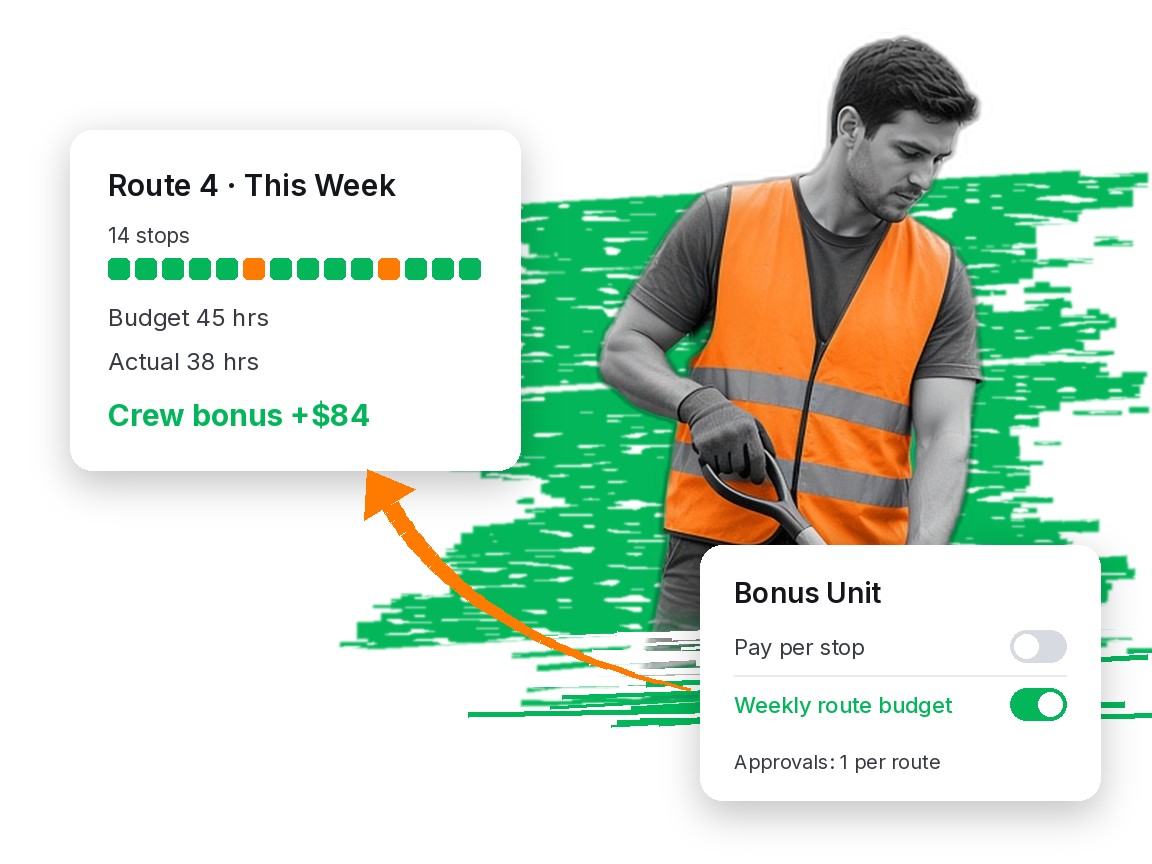
Below: the same week under both designs, how to split one route bonus across a crew, when per-stop still makes sense, the failure modes, and how to run it.
Why maintenance is different from install work
On an install, the job is the natural unit. A patio has a start, a finish, and a labor budget. Beat the budget, share the savings. (That model is laid out in Should I pay my crew hourly or by the job?)
A maintenance route doesn't work like that. The same crew hits the same 12 to 20 properties every week, each one small, often an hour or two of crew time. The variance on any single stop is mostly noise: soaked turf after Tuesday's rain, a locked gate, a dog in the yard. Over a week those swings wash out. On a single stop they decide everything.
So the question isn't really "stop or week." It's "what unit is big enough that the crew's effort shows up, and the noise doesn't?" On recurring maintenance, that unit is the route-week.
Worked numbers: the same week, two designs
These numbers are illustrative, not customer data. They're meant to show how the math behaves.
Say Route 4 has 14 stops a week. The stop budgets add up to 45 hours of crew time. Loaded labor rate for the example: $24/hour. Split: 50/50 between the company and the crew.
The crew has a good week. Twelve stops come in under budget by a combined 9 hours. Two stops run over: one property was waterlogged and took twice as long, and another had a locked gate and a 40-minute wait. Together they ran 2 hours over. Total actual: 38 hours.
Design A: stop-by-stop, overs pay zero.
- Twelve stops under budget: 9 hours × $24 = $216 in "savings"
- Crew share at 50%: $108
- The two over-budget stops pay $0, but nothing comes off
The problem: you didn't actually save 9 hours. You saved 7. The crew collected $108 out of $168 in real savings. That's 64%, not the 50% you announced. Run that across ten routes and a full season, and the program quietly costs more than it saves. That's the opposite of how a self-funding bonus is supposed to work.
Design B: stop-by-stop, overs net against unders.
Some owners fix that by subtracting the overs from the unders. Now the crew earns 7 hours × $24 × 50% = $84. The math is right, but you've built a weekly budget with fourteen times the paperwork, and crews still see a red mark next to the waterlogged property they couldn't control.
Design C: one weekly route budget.
- Route budget: 45 hours
- Actual: 38 hours
- Saved: 7 hours × $24 = $168
- Company keeps $84. Crew earns $84.
Same dollars as Design B, with one number, one approval, and one line on the statement. The slow stop just costs a little of the week's cushion.
And if the crew runs 47 hours against the 45-hour budget? The bonus is $0, base pay doesn't change, and next week starts fresh.
Splitting one route bonus across the crew
A weekly bonus raises a fair question: who gets what, when people move between trucks?
The cleanest rule is that everyone who logged hours anywhere on the route that week shares the crew pool, weighted by hours. Continuing the example, the $84 crew pool splits like this:
| Crew member | Hours on Route 4 | Share of $84 |
|---|---|---|
| Crew lead | 16 | $35.37 |
| Crew member | 14 | $30.95 |
| Floater (helped Wednesday) | 8 | $17.68 |
| Total | 38 | $84.00 |
That's about $2.21 per hour on the route. The floater gets paid for the day he worked, and nobody argues about it. Weighting the crew lead higher is fine, as long as the rule is written down before the week starts.
Where a per-stop budget still makes sense
Weekly isn't a religion. There are three cases where the unit should be something else.
Big single properties. If one commercial site takes a full crew all day, that "stop" is really a job. Give it its own budget, or put it on its own route.
Enhancements and add-ons. A mulch install, a cleanup, or extra plantings sold to a maintenance customer is one-off work. Budget it like an install, as its own job, and keep it out of the route week. Otherwise a big add-on either pads the route budget or swamps it.
Solo route techs. Spray techs, pool techs, and other one-person trucks still fit a weekly route budget. A route can be one person. The difference is that the pool is just that person, so you skip the split. Some owners pair it with a per-person production goal instead. (Non-landscape trades can set this up the same way, but the case studies further down are landscaping results.)
For a whole branch of maintenance contracts, there's also a bigger unit: a monthly labor-percent budget. Illustrative example: $720,000 in monthly revenue × a 40% labor target ÷ $24 loaded rate = a 12,000-hour budget for the branch. The branch uses 11,400 hours, 600 under. 600 × $24 = $14,400, split 50/50: $7,200 to the crew pool. One approval a month. It suits steady contract revenue, but weekly route budgets are better when you want each crew to see its own score.
Failure modes: how route bonuses go wrong
Route budgets set from the bid, not from history. This is the big one. If a route has never come in under its budget, the budget is the problem, not the crew. Check every route against the last twelve months of actual hours before launch. A route budget that's 18% too tight means the crew can have a great week and still earn nothing. (More on that in Why do most crew bonus programs fail after 90 days?)
Contract changes that never reach the budget. A customer adds a bed or drops a service, and the route budget still reflects last year's visits. Re-check route budgets whenever contracts change and at the start of each season.
Quality slipping. Maintenance has a built-in check: you're back in seven days, and the customer will tell you. A callback or missed area comes off the next bonus, flagged the day it happens. (The full set of quality and safety gates is in Won't performance pay make my crews rush the work?)
Paying when the route missed. A bonus on a fair week that ran over budget "because they worked hard" starts an expected raise. Hold the line on fair weeks; fix the budget on unfair ones.
Too long a period. By week three of a monthly route bonus, nobody remembers week one. Match the period to payroll.
How to run it, week to week
- Build route budgets from history. Compare each route's summed stop budgets against twelve months of actual hours. Fix outliers before anyone sees a number.
- Write the rules once. Period, split, how the pool divides, drive time, callbacks, add-ons. Same rules on every route.
- Lead with the base-pay line. Hourly pay isn't changing. This is a bonus on top, funded by hours the route saves. Over budget pays zero, never negative.
- Show the score during the week. Crews should know on Wednesday how many hours are left and what they're on pace to earn.
- Approve once per route. Review flagged routes, approve the clean ones, pay with regular payroll. If this takes more than about twenty minutes a week once the data is flowing, the process is still too manual.
- Tune routes quarterly. Routes that never win and routes that always win by a mile both have budget problems. Fix them on a schedule, not in the middle of an argument.
What it looks like when it works
Promier Landscapes (Kingsport, TN; 35 field staff; numbers verified by an outside landscaping CFO at B Advisory) ran a year on savings-share performance pay with the same crew. Revenue grew 17.5% ($7.5M to $8.8M). Labor cost as a share of revenue fell from 21.8% to 19.9% while wages went up. That came to about $165,000 in field labor savings, and 4,877 hours moved back to billable work.
Mulhall's Landscaping (Omaha; 30+ years in business). Mick Mulhall: "Protiv has been the most impactful thing we've ever done to drive operational performance. We saw the impact in one month."
Those are landscaping companies, and they're proof points, not a promise. The idea behind them is the one in this post: pay from real savings, in a unit the crew can actually influence.
Where Protiv fits
You can run weekly route budgets in a spreadsheet. The hard part is rolling up stops, tracking crews that change trucks, and approving on time every week. Protiv handles that with Group ProPays, which combine every job a route finishes in a week or two-week period into one bonus. Budgets and hours are summed, so a slow stop is offset by a fast one. Everyone who worked on the route shares the crew pool, and the manager approves the whole group once. If your scheduling software doesn't use routes, Protiv can give each crew lead a route. Crews see hours left and what they're on pace to earn in the crew app, and quality and safety rules clear before any bonus pays. The framework is yours. Protiv runs it every week.
FAQ
Should drive time count against a maintenance route budget?
Either way works if you pick one rule and use it on every route. Leaving drive time out, as paid company time, keeps the bonus on work done at the property, so crews aren't penalized for traffic. Putting it in rewards tight routing and fewer supply runs, but the budget then needs realistic drive time. Most arguments come from changing the rule mid-season or treating routes differently, not from which rule you picked.
What happens when one stop takes far longer for reasons the crew couldn't control?
A weekly budget absorbs most of it, since the other stops offset the slow one. If one event wipes out the whole week, like a storm cleanup or a broken irrigation main, treat it as a budget problem, not a crew problem. Adjust that stop's budget or pull the extra work out as its own job. Write that rule down before launch so it doesn't look like favoritism when you use it.
Weekly or every two weeks?
Match your payroll cycle. Bi-weekly payroll fits a two-week route period on one statement and gives the crew more room to absorb a bad day. Weekly payroll fits a weekly period with faster feedback. What doesn't work is a period much longer than the pay cycle; a monthly route bonus is too far away for crews to connect to Tuesday's choices.
How do I split a route bonus when crews change during the week?
Let the crew pool cover everyone who logged hours on the route that period, split by hours worked. A one-day floater gets a one-day share. To pay crew leads more, add a crew-lead share or weight by wage, decided up front. The route's savings set the size of the pool; the split only decides who gets which slice.
Does a weekly bonus let crews slack on the hard stops?
Not if quality has teeth. Recurring maintenance shows its quality fast: you're back next week and the customer sees every miss. Make callbacks and missed areas come off the next bonus, flag them the day they happen, and require the route to clear quality and safety rules before anything pays. A weekly budget actually lowers the urge to rush, because one slow, careful stop doesn't cost the crew its whole bonus the way it does under a per-stop design.
Soft next step
Before you pick a design, pull twelve months of hours for your three busiest routes and compare stop budgets to actuals. That tells you whether your budgets are ready for a bonus and which routes need fixing first.
When you're ready to run that on your own routes, talk to the Protiv team.