
Below: the math on one job, what each side of the split actually pays for, how to divide the crew's share, the failure modes, and how to run it.
Why the split matters more than the bonus formula
Owners spend their energy on the budget and almost none on the split. But the budget only decides whether savings exist. The split decides whether anybody believes the program is fair.
This assumes you have already decided to keep the hourly wage and add a bonus funded by labor the crew saved (see Should I pay my crew hourly or by the job?). Now you have to decide who gets what.
A split does three jobs at once. It sets the size of the prize: too small, and the crew decides it is not worth hustling for. It protects the company's margin: if the crew takes everything, your labor percentage stays flat and you have just added admin. And it tells the crew how much of a partner they are. A split you have to defend in whispers is the wrong split.
The worked numbers: one job, four splits
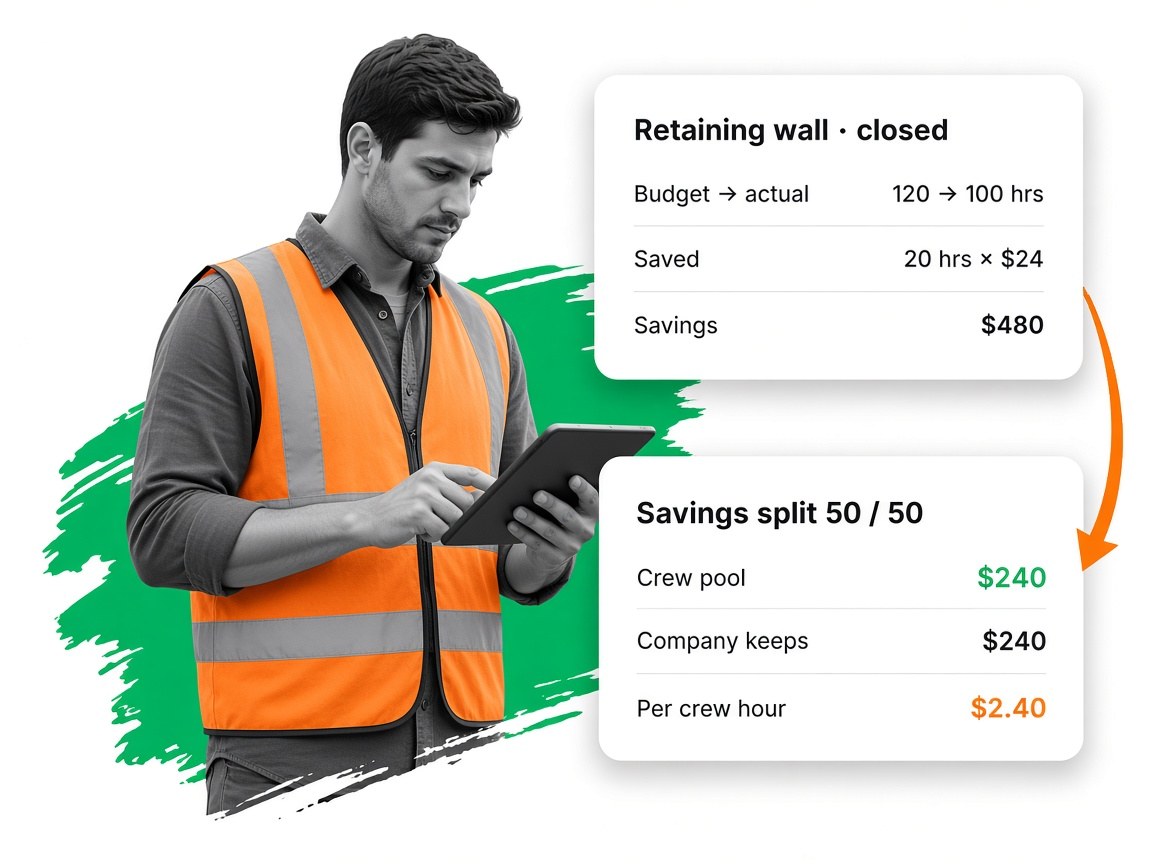
Take a retaining wall install with a labor budget of 120 hours. A four-person crew finishes in 100 hours: the crew lead logged 28 and three crew members logged 24 each. Loaded labor rate for the example is $24 per hour.
Hours saved: 20
Savings: 20 × $24 = $480
Here is what the same $480 looks like under four splits. "Per crew hour" is the crew pool divided by the 100 hours the crew worked.
| Split | Crew pool | Crew lead share | Company keeps | Per crew hour | A 24-hour crew member gets |
|---|---|---|---|---|---|
| 30% crew / 70% company | $144 | none | $336 | $1.44 | $34.56 |
| 50% crew / 50% company | $240 | none | $240 | $2.40 | $57.60 |
| 70% crew / 30% company | $336 | none | $144 | $3.36 | $80.64 |
| 40% crew / 10% lead / 50% company | $192 | $48 | $240 | $1.92 | $46.08 |
Under 50/50, the crew lead with 28 hours earns 28 × $2.40 = $67.20 and each crew member with 24 hours earns $57.60. That is on top of full wages for every hour.
Under the last split, the lead earns 28 × $1.92 = $53.76 from the crew pool plus the $48 lead share, or $101.76. Each crew member earns 24 × $1.92 = $46.08. The company's half did not change. The lead's extra came out of the field side.
What never changes in any row: full wages for every hour, and no bonus on a job that runs over budget.
What the company's half actually pays for
Crews can hear "the company keeps half" as "the owner pockets half." Be ready to say what that half covers.
A lower labor percentage. That is the point. If the company keeps nothing, labor cost on that job is the same as if the crew had used all 120 hours.
The real cost of the bonus. A bonus is wages. A non-discretionary bonus (one promised in advance for hitting a target) also raises the regular rate for overtime purposes. Example: a crew member earns a $400 bonus in a week where they worked 50 hours, 10 of them overtime. The bonus works out to $8.00 per hour, half-time on that is $4.00, and the overtime adjustment is $40. Confirm the details with your payroll provider, and plan for it in the company's share.
The misses that are not the crew's fault. When an estimate was wrong or the customer changed the scope, the side that set the budget should absorb it, not the crew. (More on that in What should I do about callbacks and rework in a crew incentive plan?)
Capacity. The 20 hours that crew did not use are available for the next job.
At scale, the math gets serious. In Protiv's illustrative planning model, a $20M company running 35% labor that gets 10% more efficient saves about $700,000 in labor. On a 50/50 split, about $350,000 goes to crews and about $350,000 stays with the company. That is an illustration, not a guarantee, but it shows the split does not have to be stingy to be worth it.
How to divide the crew's share
The split between company and crew decides the size of the pool. A second decision decides who inside the crew gets what. Keep these separate in your head and in your rules.
By hours worked. Everyone earns the same bonus per hour on the job. The person who worked 28 hours earns more than the one who worked 10. It is simple and nobody can argue the math.
By hours and hourly wage. Higher-paid people earn more bonus per hour, in proportion to their wage. It rewards experience, but widens the gap between the newest crew member and the lead.
A separate crew lead share. If your leads plan the day, run the material, and own the quality walk, a dedicated slice (like the 10% in the table) pays for that. Take it out of the field side, not the company side, unless you have decided to raise the total field share on purpose.
One more rule: decide what happens to people who are not eligible yet, such as someone still in a probation period. A clean approach: their hours still count toward the job's cost, but their share is redistributed to the rest of the crew.
Should the split change by type of work?
Sometimes. Not often.
The type of work changes the shape of the bonus more than the split. Installs fit a job budget. Recurring maintenance fits a weekly route budget (see Should I bonus maintenance routes stop-by-stop or by the week?). Large multi-week jobs fit phased budgets with part held until the job closes. The split can stay 50/50 across all of them. Override it by branch, route, or job only with a reason you can say in one sentence. Every override is one more thing crews will compare.
Failure modes: how splits go wrong
The crew share is too small to matter. At 30%, the crew member in the example earns $34.56 for helping save 20 hours. If your best crew decides that is not worth the effort, the split failed, however good your margin looks.
The crew gets everything. A 100% crew share leaves the company no margin gain, no money for the overtime adjustment, and no cushion for its own estimating misses. Owners who start there usually cut it later, and a cut feels like a betrayal.
The split changes after launch. Nothing kills trust faster than a split that moves the month savings show up. Change it going forward only, announce it first, and never touch jobs already approved or paid.
Hidden pools. A manager share or custom pool the crew does not know about will be found. Put every pool in the written rules.
The budget does the splitting. Loose budgets make a 30% share pay a lot; tight ones make a 70% share pay nothing. Fix the budgets first (see How do I know my labor baseline is honest before I start a crew bonus program?), then set the split.
Nobody can explain their check. If a crew member cannot trace their bonus from hours saved to their own share, the split might as well be random (see Why do most crew bonus programs fail after 90 days?).
How to run it
- Model it on last year first. Run your last twelve months of jobs through two or three candidate splits. Pick the one where both the crew's weekly bonus and the company's share make sense.
- Write the rules on one page. Every pool, how the crew pool is divided, who is eligible, what happens over budget, and which paycheck it lands on.
- Say the base-pay line first. Wages are not changing. This is on top. Over budget, the bonus is zero and base pay stays the same.
- Show the split on every statement. Savings, crew pool, hours, share. No mystery lines.
- Hold the split for at least a season. Review it quarterly with real numbers, not because one job paid more than expected.
- Pilot it. One branch, about ninety days. Change the split only after you have seen real payouts.
What it looks like when both sides win
Promier Landscapes (Kingsport, TN; 35 field staff; verified by an outside landscaping CFO at B Advisory) ran a year with bonuses paid out of savings. Labor cost as a share of revenue went from 21.8% to 19.9% while wages went up, field labor savings came to about $165,000, and revenue grew from $7.5M to $8.8M with the same crew. That is what a fair split is supposed to do: the crew takes home more, and the company's labor percentage still drops.
That is a landscaping result. The same split can be set up for painting, HVAC, electrical, or plumbing crews, but the published results so far are from landscape companies.
Where Protiv fits
Once the split is decided, the hard part is applying it the same way on every job and showing each person why they got what they got. That is the part Protiv handles. You set a bonus pool split once (crew onsite, crew lead, manager, company, and an optional custom pool, totaling 100%) as a company default, and override it by branch, route, or a single job only where you need to. The crew pool is divided by hours worked, by hours and wage, or with a crew lead weighted by wage. Each person's statement shows their line items. The framework above is the answer; the software keeps it consistent.
FAQ
Is 50/50 the right split for labor savings?
It is the right place to start, not a rule. A 50/50 split is easy to explain, pays the field enough to notice, and leaves the company enough to lower its labor percentage and cover the real cost of the bonus, including any overtime adjustment. Move away from it only with a reason you can state in one sentence, and keep the field side around 40 to 60 percent.
Should the crew lead get a bigger share than the crew?
Usually, yes, if the lead actually runs the job: planning the day, managing material, and owning the quality walk. Splitting by hours already pays the lead for their own hours. A separate crew lead share, often carved out of the field side, pays for the responsibility. In the example, a 10% lead share on a $480 job added $48 to the lead's bonus without changing what the company kept.
How do I divide the crew's share among the people on the job?
Most companies split the crew pool by hours worked, so everyone earns the same bonus per hour and the person who worked more hours earns more. Splitting by hours and hourly wage pays more per hour to higher-paid people. Equal shares are simple but hard to defend when hours differ a lot. The method only decides who gets what inside the pool, not the pool's size.
Can I change the split after we launch?
You can, but do it rarely and never backward. Change it going forward only, announce it before it takes effect, and leave every job that was already approved or paid alone. Tie any change to a scheduled review with real numbers, not one big payout.
Who absorbs the loss when a job goes over budget?
Under the model in this post, an over-budget job pays no bonus, and every hour is still paid at the full wage. The company carries the extra labor cost, which is one of the reasons it keeps a real share of the savings on the jobs that come in under. If you also carry overages against future bonuses, write it in the rules, cap it, and separate crew-caused overruns from bad estimates.
Soft next step
Before you announce a split to the field, run your last twelve months through it: what a typical crew member would have earned, which budgets never would have paid, and what the company would have kept. If those numbers do not make sense together, no kickoff speech will fix it.
Talk to the Protiv team when you want to model your split on your own data.