
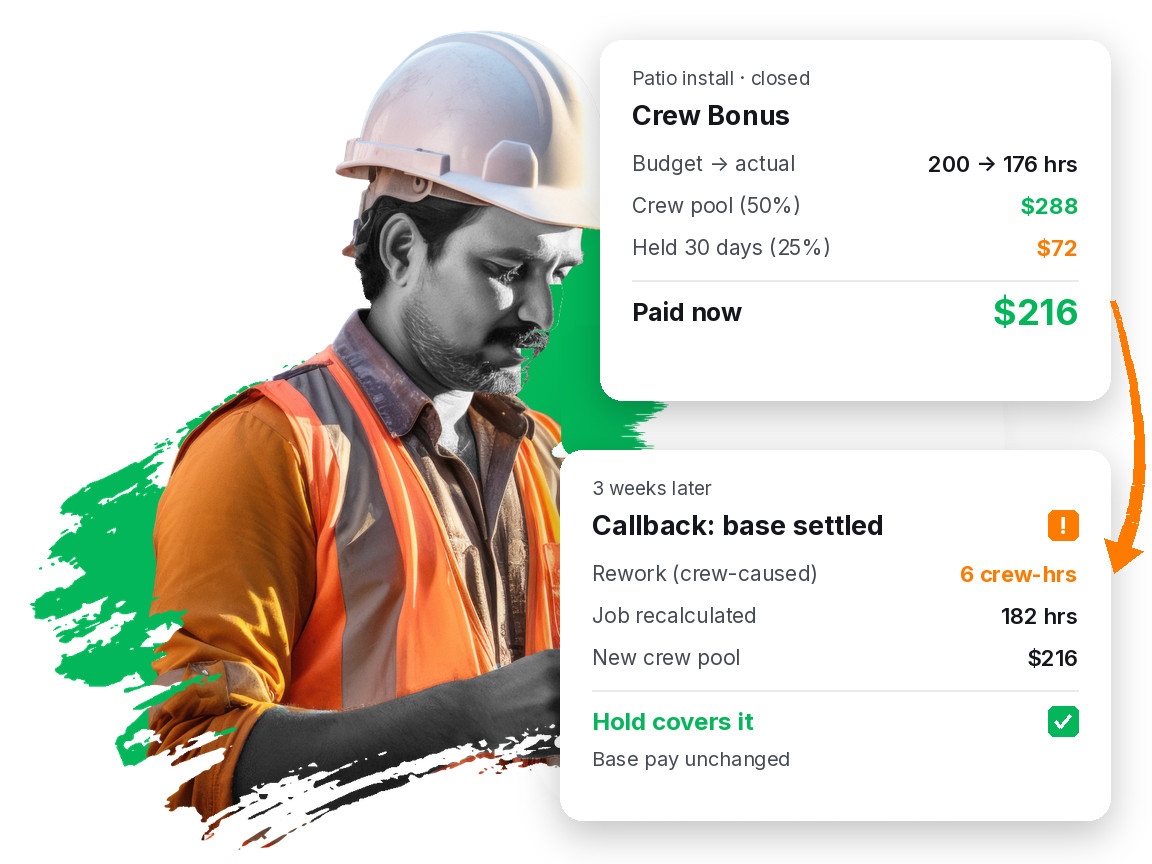
Below: how to sort a callback, one callback handled three ways with numbers, how to set the hold and window, the failure modes, and how to run it.
Why callbacks are the hardest rule in the plan
Most of a performance pay plan is settled when the job closes: budget known, hours in, walkthrough passed, bonus approved. Callbacks show up after the money is gone. A paver base settles three weeks later. An irrigation zone that tested fine floods a bed in the first heat wave.
So owners either ignore callbacks and pay bonuses on work done twice, or overreact and dock checks in ways crews read as a clawback. One teaches that speed is all that matters; the other, that the bonus can be taken back anytime.
Won't performance pay make my crews rush the work? covers the gates: safety stops the bonus, quality has to pass the walkthrough, callbacks come off the next check, part of the bonus is held. This post is about what comes after the gate: what to actually do with a callback when it lands.
Step one: sort the callback before you charge anyone
Every callback gets a cause before it gets a cost. Write this sort into your rules and use it the same way every time.
| What caused it | Example | Who carries it |
|---|---|---|
| Crew workmanship | Skipped compaction, loose edging, damage the crew caused | Crew bonus, through the original job |
| Estimate or design | Wrong base depth on the plan, too few hours sold | Company; fix the budget for next time |
| Material defect | Bad batch of block, failed part | Company (and the supplier, if you can) |
| Customer change | "Can we move the bed two feet?" | Change order, billed to the customer |
| Weather or outside damage | Washout after a record storm | Company |
Only the first row touches the bonus. When you are not sure, look before you charge: job photos, the walkthrough notes, the crew lead's account. If you still cannot tell, give the crew the benefit of the doubt and note it.
A crew will accept losing part of a bonus for a callback it caused. It will not accept paying for your estimator's mistake, and it will remember.
The worked numbers: one callback, three ways to handle it
Here is one install job and one callback, handled three ways. Illustrative numbers, using the same $24 loaded labor rate and 50/50 split as the rest of this series.
The job as it closed:
- Labor budget: 200 hours
- Actual: 176 hours
- Hours saved: 24 × $24 = $576 in savings
- Crew pool at 50%: $288
- Held for the 30-day callback window (25%): $72
- Paid on this check: $216
Three weeks later, part of the patio settles. The cause is the crew's: one section of base was not compacted. The fix takes 6 crew-hours of paid rework, or $144 of labor at $24.
Option A: charge the rework hours back to the original job. Log the 6 hours against the original job and recalculate. Actual goes from 176 to 182 hours, hours saved drop to 18, savings drop to $432, and the crew pool drops to $216. The crew already got $216, so the $72 hold just is not released. Net to the crew: $216 instead of $288. The crew carried $72 of the $144 rework cost; the company carried the other $72. Nothing comes off a future check.
Option B: charge the full rework cost as a deduction. Take all $144 off the crew. The $72 hold covers half, and $72 comes off the next statement. Net to the crew: $144.
Option C: ignore it. Release the $72 on schedule. The crew keeps all $288, and the company pays the full $144 to fix it.
Most owners should start with Option A. It splits the cost of a mistake the same way you split the savings, so the rule explains itself: "You share in the hours you save, and you share in the hours you have to come back for." It scales with the size of the mistake, and it uses the hold the way it was meant to be used.
Option B fits repeat problems or plain carelessness. A small flat penalty can handle minor items like a missed cleanup. Avoid Option C as a habit: it pays the crew that rushed the same as the crew that did it right.
Who fixes it, and how they get paid
If the original crew is nearby and the fix is small, send them back. Seeing it themselves teaches more than any deduction.
When a different crew does the fix, two rules keep it fair:
- The fixing crew gets paid in full for every hour, and those hours do not count against its own job budgets. Its bonus should not suffer for someone else's callback.
- The cost still lands on the original job. Record the rework hours against the job that caused them so the Option A recalculation still works.
And one rule for everyone: rework hours are work hours. Nobody fixes a callback off the clock "because it was their mistake." The base wage is never the lever. The bonus is.
Setting the holdback and the window
Match the window to when problems surface. Settling, drainage, and irrigation problems on install work tend to show up within weeks, so 30 days is a common starting point. Recurring maintenance is the exception: you see the quality on the next visit, so a penalty on that week's route bonus beats a long hold. (Should I bonus maintenance routes stop-by-stop or by the week? explains the weekly route budget.)
Size the hold to your real callback cost. Look at a year of rework hours by job type. In the example, a 25% hold covered the Option A hit exactly. If your callbacks run bigger on a job type, hold more there; if they are rare, hold less. Twenty to twenty-five percent is a reasonable place to start, not a law.
Release it on the date you said. Show the held amount and release date to the crew, and pay it on time when nothing comes in.
Failure modes: how callback rules go wrong
Charging callbacks the crew did not cause. The fastest way to kill a program. Use the sort table, and when the estimate was wrong, fix the estimate.
Surprise deductions. The crew should hear about a callback the day it comes in, with the cause and expected cost, not on a statement. Surprises are a big part of why most crew bonus programs fail after 90 days.
Open-ended clawbacks. If a callback can come off a check a year later, nobody trusts any bonus. Once the window closes, warranty work is the company's cost.
Deductions that pile up. A crew carrying a growing negative balance into every check stops caring about the bonus. Decide ahead of time whether a negative balance rolls forward in full, in part, or gets dropped, and consider a cap.
Not tracking the pattern. Three callbacks from one crew on the same kind of work is a training problem no deduction fixes.
How to run it, week to week
- Write the callback rule on one page. Cause categories, window and hold by job type, how cost is charged (Option A by default), what happens to negative balances. Cover it at kickoff, before the first callback.
- Log every callback the day it comes in. Job, cause, rework hours, who fixed it. Tell the crew lead the same day.
- Decide the cause within a few days, in writing.
- Charge it at the weekly approval. Recalculate the original job, take the difference from the hold, send anything left to the next statement. It is one more item in the weekly routine.
- Release clean holds on schedule.
- Review callbacks quarterly. Callback rate by crew and job type, crew-caused versus estimate or material, and whether holds were the right size. If one job type keeps producing estimate callbacks, the budget is the problem; see How do I know my labor baseline is honest?
What it looks like when it works
Promier Landscapes (Kingsport, TN; a 35-person crew; numbers verified by an outside landscaping CFO at B Advisory) ran a year on this model with the same crew: revenue up 17.5% ($7.5M to $8.8M), labor cost as a share of revenue down from 21.8% to 19.9% while wages went up, about $165,000 in field labor savings, and 4,877 hours moved back to billable work. Mulhall's Landscaping (Omaha; 30+ years in business): owner Mick Mulhall said, "Protiv has been the most impactful thing we've ever done to drive operational performance. We saw the impact in one month."
Both are landscaping companies. Install trades with late-showing callbacks, like roofing, concrete, solar, or HVAC installs, can set up the same sort, hold, and window, but these case studies are the proof points, not a promise for every trade.
Where Protiv fits
The hard part is the bookkeeping: what was held on which job, recalculating a paid bonus, carrying balances forward, and showing it to the crew before payday. Protiv handles that. Disqualifiers and penalties can be applied to a bonus, a warranty reserve can hold part of an install job's bonus for callbacks, and held amounts sit in a held bonus ledger so payouts can be trued up later. When a paid bonus changes, the difference goes on the next statement instead of rewriting what was paid. If a statement ends below zero, you choose whether to roll the full balance, part of it, or drop it. The rules are still yours to write.
FAQ
Should callbacks come out of the bonus or out of base pay?
Out of the bonus, always. Base pay covers every hour worked, including rework hours, and it should never move because of a callback. If a callback could ever reduce someone's hourly wage, the plan stops being a bonus on top of pay and becomes a penalty system.
How long should the callback window be?
Long enough to catch the problems that usually show up, and no longer. For install work like hardscape, drainage, and irrigation, 30 days is a common starting point. Large jobs may need a portion held until the job closes. Recurring maintenance usually needs little or no hold, since you see the quality on the next visit. Once the window closes, warranty work should be the company's cost.
What if a different crew fixes the callback?
Pay the fixing crew in full for every hour and keep the work out of its own job budgets, so its bonus is not hurt by someone else's mistake. Then record those rework hours against the original job so the original crew's bonus gets recalculated. If the original crew is close by and the fix is small, sending them back is usually better.
What happens if the callback costs more than the bonus that was held?
The difference comes off the next statement, like any other change to an already-paid bonus. Decide ahead of time what happens if that leaves a crew negative: roll the full balance forward, roll part of it, or drop it. Many owners cap what one callback can take. If it keeps happening, the hold is too small for that job type.
Should the whole crew pay for one person's mistake?
Usually yes, at the crew level, because the crew works the job together and the crew lead signs off before it closes. Charging individuals invites finger-pointing. Clear individual damage or a repeat pattern from one person is a management conversation, not a bonus formula. Put your choice in the written rules.
Soft next step
Pull the last twelve months of callbacks and sort each one with the table above: crew, estimate, material, customer, or weather. Then run the crew-caused ones through Option A and see what they would have cost each crew. That shows whether your hold and window fit your work.
When you want to model that on your own jobs and hours, talk to the Protiv team.