
Below: why one big end-of-job bonus fails, a three-phase job with real numbers, how to measure progress honestly mid-phase, the failure modes, and how to run it.
Why one bonus at the end doesn't work on a long job
On a one-day or three-day job, a single job budget works fine. The crew starts, finishes, the job gets approved, and the bonus lands on the next check. (If you haven't set that up yet, start with Should I pay my crew hourly or by the job?)
Stretch the same idea across a ten-week commercial install and three things break.
The reward is too far from the work. Performance pay works because of the link between what a crew does today and what lands on their check. When the payout is two months out, nobody connects a sharp Tuesday to it.
One bad week poisons the rest. If the whole job is a single budget, a rough stretch in week three can put the job "underwater" on paper. Once a crew decides the bonus is gone, it stops pushing for the remaining seven weeks.
The crew changes. People rotate on and off long jobs. One end-of-job payout either pays people who weren't there for the good stretch or forgets people who were.
Phases solve all three. Each phase is short enough to feel, it stands on its own budget, and it pays the people who actually worked it.
The worked numbers: one job, three phases
Take a commercial landscape install with a total labor budget of 2,000 hours, split into three phases that match how the estimate was built. The loaded labor rate for the example is $24 per hour. The split is 50/50 between the crew and the company (see How do I split labor savings between the company and the crew?), and 20 percent of each phase's crew share is held until the job closes.
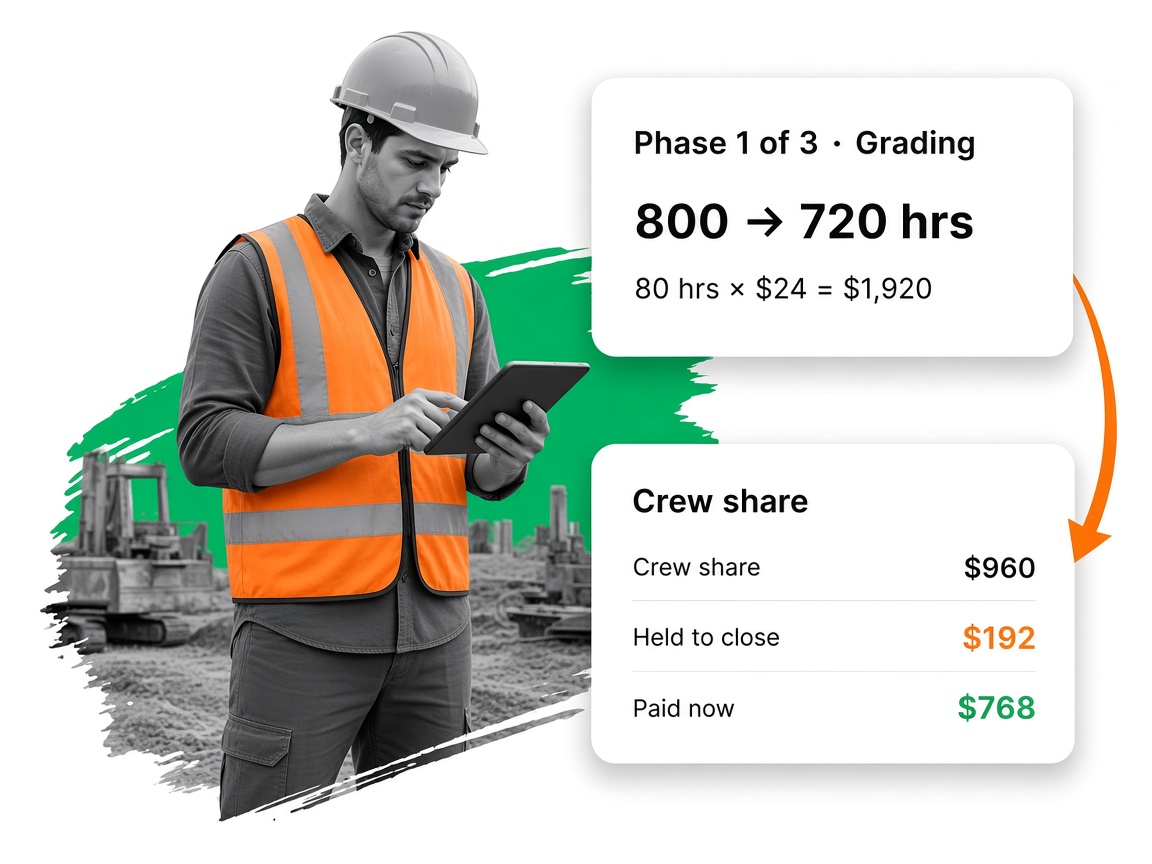
Phase 1: grading. Budget 800 hours. Actual 720 hours.
80 hours saved × $24 = $1,920 in savings.
Crew share 50% = $960. Held to close 20% = $192. Paid now = $768.
Phase 2: hardscape. Budget 700 hours. Actual 760 hours.
60 hours over budget. Phase 2 pays no bonus. Phase 1 stays earned.
Phase 3: planting and finish. Budget 500 hours. Actual 440 hours.
60 hours saved × $24 = $1,440 in savings.
Crew share 50% = $720. Held to close 20% = $144. Paid now = $576.
| Phase | Budget | Actual | Savings | Crew share | Held to close | Paid at phase approval |
|---|---|---|---|---|---|---|
| 1. Grading | 800 h | 720 h | $1,920 | $960 | $192 | $768 |
| 2. Hardscape | 700 h | 760 h | over budget | $0 | $0 | $0 |
| 3. Planting and finish | 500 h | 440 h | $1,440 | $720 | $144 | $576 |
| Total | 2,000 h | 1,920 h | $1,680 | $336 | $1,344 |
The crew collects $1,344 while the job is running, on the checks after Phase 1 and Phase 3 are approved. The $336 held back is released when the job passes the final walkthrough and the punch list is closed.
Inside each phase, the crew share is divided by hours worked on that phase. In Phase 1, $960 across 720 hours is $1.33 per hour. A crew member who logged 150 hours on the grading earns $200: $160 now and $40 at close. Someone who joined in Phase 3 earns nothing from Phase 1, which is fair, because they weren't there for it.
The honest trade-off: phases versus one budget
Run the same job as one 2,000-hour budget and the math changes. Total actual was 1,920 hours, so the job saved 80 hours, or $1,920. At 50/50, the crew earns $960, paid once, after the job is over.
Phases paid the crew $1,680 on the same job. The difference is Phase 2. As a whole job, its 60-hour overrun ate most of the savings from the other two phases. In a phased plan, it doesn't take anything back from Phase 1 or Phase 3.
Know that before you start, because it cuts both ways. On this job, the company saved $1,920 of labor overall and paid $1,680 of it in bonuses. It kept $240. That is still a job under budget with a crew that got paid for its good phases, but it is not the 50/50 result the split suggests.
That is not a reason to skip phases. It is a reason to set phase budgets carefully, because a soft phase budget pays out, a tight one pays nothing, and the two don't cancel. If you can't defend each phase's hours, fix the estimate first (see How do I know my labor baseline is honest before I start a crew bonus program?).
Some owners also decide in advance that a crew-caused overrun on a later phase comes out of the held amount before it is released. If you do that, write it in the rules, cap it, and separate crew-caused overruns from scope changes and estimating misses. A customer who added a wall in week six didn't make the crew slower.
How to measure progress mid-phase without paying for guesses
Crews want to know where they stand before a phase is approved. Measure the finished share of the budget, not the hours spent.
If Phase 2 is 50 percent complete, it has earned 50 percent of its 700-hour budget: 350 hours. If the crew has used 330 hours so far, it is 20 hours ahead of pace. That is the number the crew should see every day.
The weak point is the percent complete. If a foreman reports 60 percent when the work is really at 50, the phase looks 90 hours ahead (420 earned minus 330 used), and the crew starts counting money that doesn't exist. Three habits keep progress honest:
- Tie progress to something you can count. Square feet of pavers laid, linear feet of wall, cubic yards placed, or milestones completed, not a gut feel.
- Show progress as a projection, not a payment. Nothing pays until the phase reaches 100 percent and a manager approves it. At approval, the bonus is simply the full phase budget minus the full phase cost.
- Have the person who checks quality sign off on progress. The manager who walks the site, not only the crew lead whose bonus depends on it.
How to cut a job into phases
Use the stages already in your estimate. Grading, hardscape, planting. Demo, rough-in, finish. If the estimate prices the work by stage or cost code, those are your phases.
Aim for phases of roughly two to four weeks. Shorter than a week and the approvals become busywork. Longer than a month and you're back to a reward that feels too far away.
Set a minimum size. A two-day job doesn't need phases. Phase only jobs above an hours threshold.
Give every phase its own budget, and make the phase budgets add up to the job budget. No hidden hours, and no phase quietly carrying another one's cushion.
Don't phase recurring work. Maintenance routes are a different problem with a different answer (see Should I bonus maintenance routes stop-by-stop or by the week?).
Failure modes
Paying on percent complete with no holdback. You've paid for work that may need to be redone. The holdback is what keeps the last 10 percent of a job, the punch list everyone hates, from becoming somebody else's problem.
Phase budgets nobody believes. If Phase 1 is padded and Phase 3 is starved, the crew learns the bonus depends on the phase, not the work.
Holding money with no clear release rule. Crews will accept a holdback they can see on their statement with a release date and a reason. They won't accept money that disappears into "we'll see." Say exactly what releases it: final walkthrough passed, punch list closed, no callback inside the hold window. (More on that in What should I do about callbacks and rework in a crew incentive plan?)
Rushing the end of a phase. If a crew can call a phase "done" and leave loose ends for the next one, it will. The approval walk has to confirm the phase is finished, and quality and safety rules apply to every phase payout (see Won't performance pay make my crews rush the work?).
How to run it
- Phase the job when it's sold, not when it starts. Set the phases, budgets, and holdback percentage before the first crew shows up.
- Post the plan to the crew on day one. Each phase, its budget, the split, the holdback, and what releases it.
- Show progress every day. Hours left in the phase and what the crew is on pace to earn.
- Approve each phase in the same weekly sitting you already use for other jobs. It's one more line on the list, not a separate process (see How much time does it take to run a crew performance pay program every week?).
- Pay the approved phase on the next check. The faster the money follows the work, the more it means.
- Close the job on purpose. Final walkthrough, punch list, then release the held amounts and show each person what they got and why.
What the published results show
Promier Landscapes, a landscape company with a 35-person crew, ran performance pay tied to labor savings for one year. Its labor cost went from 21.8% to 19.9% of revenue, it saved about $165K in field labor, and revenue grew from $7.5M to $8.8M with the same crew, verified by an outside landscaping CFO. At Mulhall's, a landscape company in Omaha, owner Mick Mulhall put it this way: "We saw the impact in one month."
Those are landscaping results. The same phased setup can be configured for commercial roofing, concrete, or general contracting jobs that run for weeks, but the published results so far are from landscape companies.
Where Protiv fits
Keeping phases, holdbacks, and approvals straight on every long job at once is the part Protiv handles. With ProPhases turned on, a non-recurring job with multiple milestones splits into phases automatically, each with its own budget and its own ProPay. You can approve one phase while others are still running, release a percentage now and reserve the rest, and track held amounts until they are released. Mid-phase, the bonus is projected from the finished share of the budget, and the crew app shows hours left and what the crew is on pace to earn. The framework above is the answer. The software keeps it consistent.
FAQ
How many phases should a long job have?
Usually three to five. Use the stages already in your estimate and aim for phases of about two to four weeks each. Fewer phases and the reward drifts too far from the work; more and approvals turn into paperwork. Every phase needs its own labor budget, and the phase budgets should add up to the full job budget.
How much of each phase payout should I hold back until the job closes?
A holdback of about 20 percent of the crew's share is a practical starting point. It's large enough that the crew cares about the punch list and the final walkthrough, and small enough that most of the money still arrives while the work is fresh. In the example, a $960 phase share pays $768 now and holds $192. Whatever you pick, show the held amount on every statement with the rule that releases it.
What happens if one phase goes over budget?
In the plan described here, that phase pays no bonus, and every hour is still paid at the full wage. It doesn't take back a phase the crew already earned. That's what keeps a crew pushing after a rough stretch, but it also means a soft budget on one phase and a tight budget on another don't cancel out. Set phase budgets carefully, and if you decide crew-caused overruns come out of the held amount, write that rule down before the job starts.
Who gets paid when people move on and off a long job?
Each phase pays the people who logged hours on that phase, split by hours worked. A crew member who did 150 hours of grading earns their share of grading even if they moved to another job before the hardscape started. Someone who joined for planting earns from planting only.
Should I pay on percent complete instead of waiting for a phase to finish?
Show percent complete as a projection so the crew knows where it stands, but pay when the phase is finished and approved. Percent complete is an estimate; reported high, it shows the crew money that doesn't exist. Tie progress to something you can count, like square feet or linear feet, and have the person who checks quality sign off on it.
Soft next step
Pick your three longest jobs from last year. Cut each one into the phases your estimate already uses, and look at what each phase budgeted against what it actually took. If the phase budgets don't hold up, that's where to start, before any crew hears about a bonus.
Talk to the Protiv team when you want to model phased incentives on your own job history.